
Privacy and local processing
How Orbis3D processes your files on your own computer, what it stores in your browser, what network requests it makes, and how to remove stored data.
You will learn
- Where your files are processed.
- What Orbis3D stores in your browser.
- Which network requests Orbis3D makes.
Prerequisites
None. This is a good place to start.
Your files stay on your computer
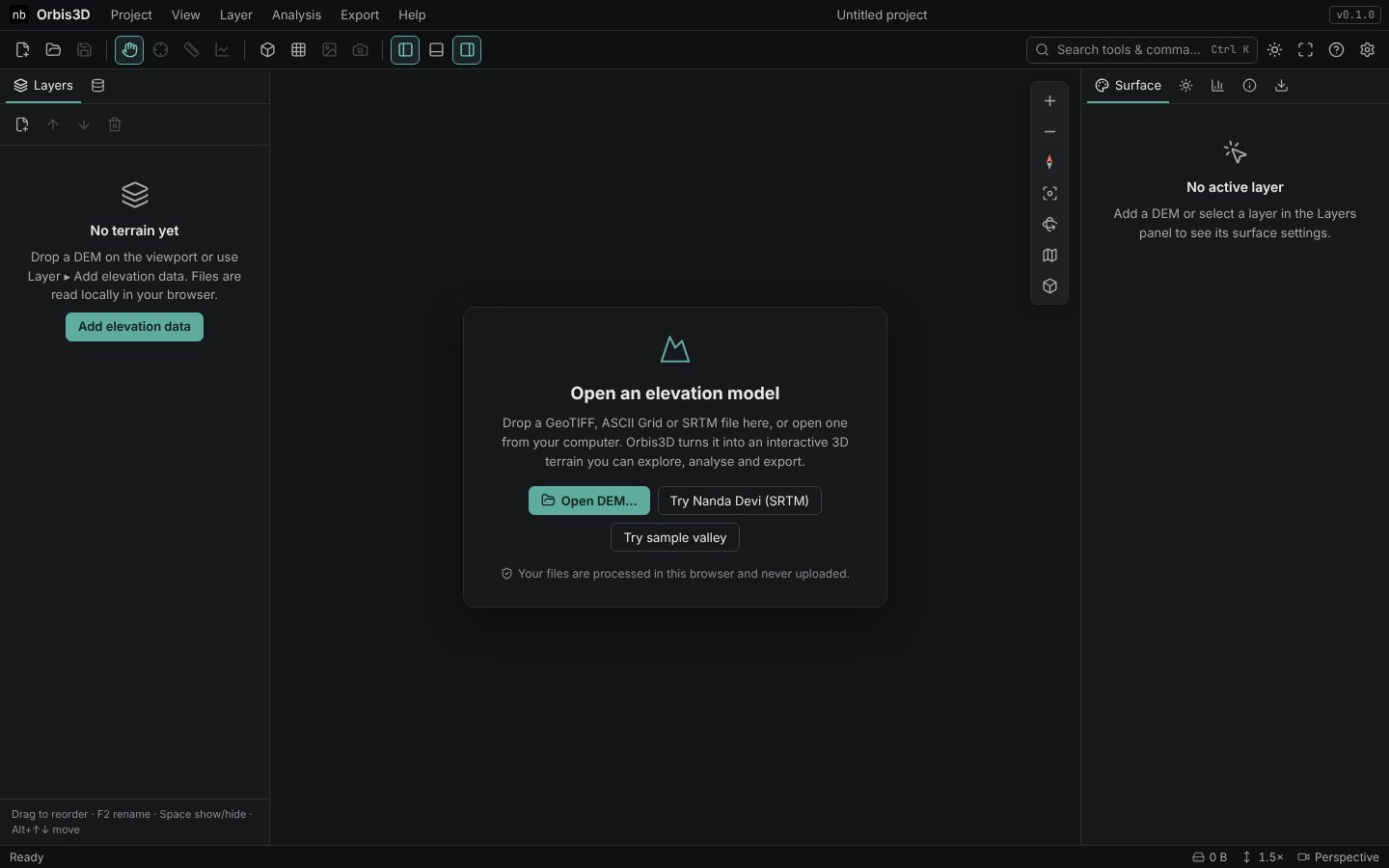
Orbis3D is a static website. When you open a DEM or an image, your browser reads the file from your disk and Orbis3D processes it in background workers inside the browser tab. There is no server-side processing, no upload, no account and no file-content analytics. You can use it with confidential survey data.
Network requests
Orbis3D only loads its own files from its own website:
- the application (HTML, JavaScript, styles, icons);
- the tutorials and the sample datasets, when you open them;
- nothing from other websites: no web fonts, maps, analytics, advertising or tracking.
The site sends a Content Security Policy that tells the browser to refuse connections to any other address. Orbis3D's browser test checks that no request goes to another host.
What is stored in your browser
| Storage | Content | When |
|---|---|---|
| IndexedDB | Projects you save with Save in this browser, including their data files | Only when you save |
| Local storage | Interface theme and performance settings | When you change them |
| Cache (service worker) | A copy of the application, tutorials and samples you opened, for offline use | Automatically |
All of it stays on your device. Nothing is synchronised to a cloud.
Exports
Exported models, images and tables are saved by your browser to your downloads folder. Orbis3D never sends them anywhere.
Removing stored data
- Delete saved projects in Project ▸ Projects in this browser….
- Remove everything (projects, settings and the offline copy) with your browser's clear site data for the Orbis3D website.
Open source
Orbis3D's source code is published under the MIT licence, so anyone can check how it handles data.